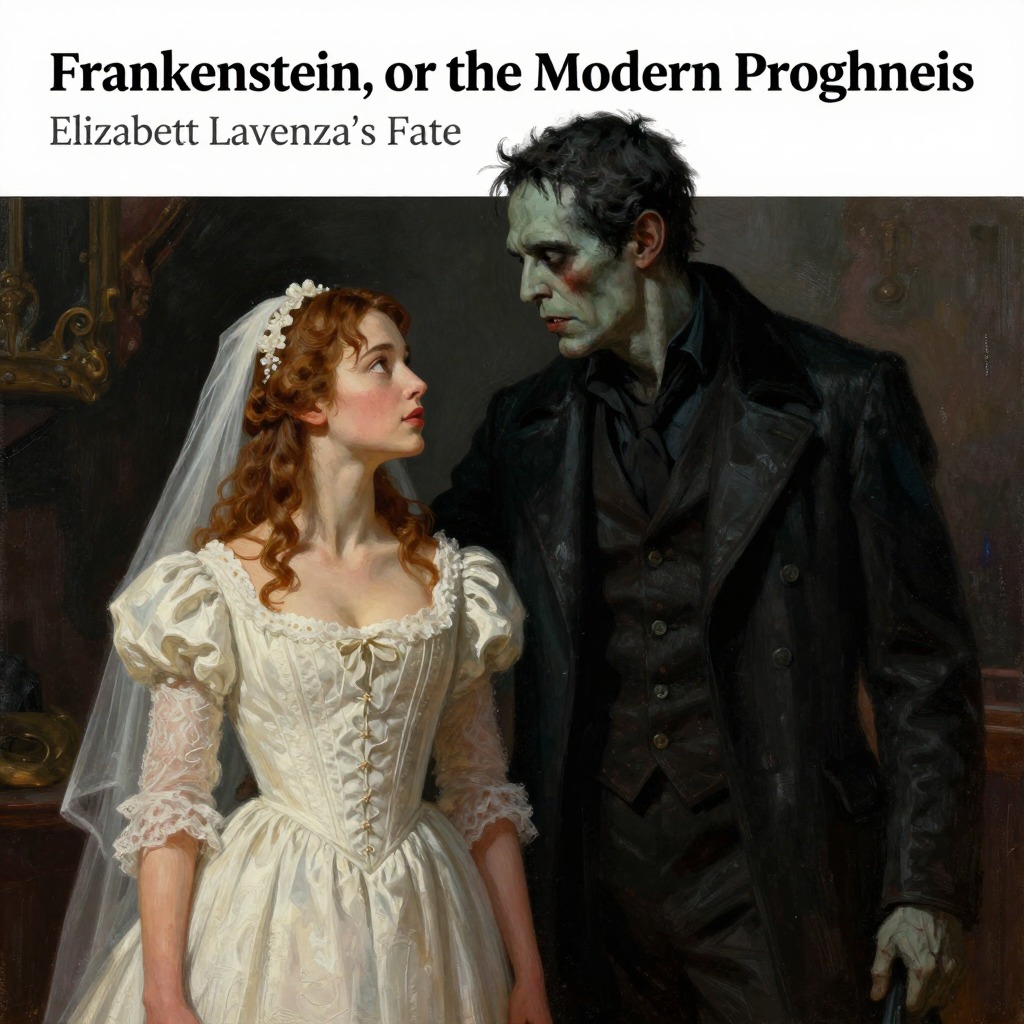
Victor Frankenstein and Elizabeth Lavenza
Victor Frankenstein and Elizabeth Lavenza are bound together from childhood by a promise that shapes their entire lives, yet their relationship becomes the central target of the monster's revenge, leading to Elizabeth's brutal death on the night of their wedding. Their story moves through three distinct phases: an idyllic childhood bond, a fraught engagement shadowed by Victor's secret, and a catastrophic marriage that ends in murder. Elizabeth functions as the emotional anchor Victor can never fully confide in, and her loss completes his destruction.
Identity and Introduction
Elizabeth Lavenza enters Victor's life as a gift. When Victor is about five years old, his mother Caroline Beaufort discovers a fair-haired, blue-eyed orphan girl living in poverty with a peasant family near the Lake of Como. Caroline prevails on the guardians to yield their charge, and Elizabeth becomes an inmate of the Frankenstein household. On the evening before Elizabeth is brought home, Caroline says playfully, "I have a pretty present for my Victor — tomorrow he shall have it." Victor interprets her words literally and looks upon Elizabeth as "mine — mine to protect, love, and cherish." They call each other cousin, but Victor insists she is "my more than sister, since till death she was to be mine only." Elizabeth is raised alongside Victor, with less than a year's difference in their ages, and their companionship is marked by harmony and contrast: Elizabeth is calmer and more concentrated, while Victor is ardent and driven by a thirst for knowledge. She busies herself with poetry and the sublime scenes of their Swiss home, while Victor investigates the hidden laws of nature. On her deathbed, Caroline joins their hands and says, "My children, my firmest hopes of future happiness were placed on the prospect of your union." This maternal blessing cements the expectation that Victor and Elizabeth will marry.
Life and Plot Trajectory
Victor departs for the University of Ingolstadt at age seventeen, leaving Elizabeth behind in Geneva. During his two years of obsessive labor creating the monster, Victor neglects his correspondence, and Elizabeth writes anxiously, begging for a single word. After the monster's animation, Victor suffers a nervous fever; Henry Clerval nurses him and conceals the severity of his illness from the family. Elizabeth's letter to Victor during his convalescence reveals her tender concern and her role as the family's emotional center: she reports on the health of Victor's father Alphonse, the growth of his younger brother Ernest, and the return of the servant Justine Moritz to the household. When Victor's youngest brother William is murdered, Elizabeth is devastated. She discovers that the miniature portrait of Caroline, which she had allowed William to wear, is missing and exclaims, "O God! I have murdered my darling child!" She accuses herself unjustly of causing William's death. Victor returns to Geneva and finds Elizabeth aged but more beautiful, her expression now full of sensibility and intellect. She pleads with him to help prove Justine's innocence, but despite her heart-rending eloquence at the trial, Justine is condemned and executed. Elizabeth tells Victor, "I feel as if I were walking on the edge of a precipice, towards which thousands are crowding and endeavouring to plunge me into the abyss." Victor, consumed by guilt, withdraws into solitude, spending hours alone on the lake, tempted to drown himself but restrained by the thought of Elizabeth. After the monster's demand for a female companion and Victor's reluctant agreement, Victor's father Alphonse raises the subject of marriage. He tells Victor that he has always looked forward to his union with Elizabeth as "the tie of our domestic comfort and the stay of my declining years." Victor, bound by his promise to the monster, cannot consent immediately. He instead proposes a journey to England, concealing his true purpose, and agrees that the marriage will take place upon his return. Elizabeth acquiesces but is filled with disquiet. She writes Victor a letter before his return from England, confessing her fear that he may love another and offering to release him from their engagement: "I love you and that in my airy dreams of futurity you have been my constant friend and companion. But it is your happiness I desire as well as my own." Victor reassures her and promises to reveal a dreadful secret the day after their marriage.
Key Actions and Objectives
Victor's central objective regarding Elizabeth is to protect her from the monster, but his every action toward that end fails. He agrees to marry her only after the monster's wedding-night threat has been uttered, believing that the monster intends to kill him and that by dying he will save Elizabeth. He carries pistols and a dagger constantly, planning to fight the monster to the death. Elizabeth's objective is to restore Victor to happiness. She soothes him when he is transported by passion, inspires him with human feelings when he sinks into torpor, and weeps with him and for him. She tells him, "While we love, while we are true to each other, here in this land of peace and beauty, your native country, we may reap every tranquil blessing." But Victor cannot share the truth with her, and his secrecy isolates them both.
Relationships and Conflict
The central conflict in Victor and Elizabeth's relationship is the secret Victor cannot reveal. He loves her "tenderly and sincerely" and declares that his "future hopes and prospects are entirely bound up in the expectation of our union," yet he cannot tell her about the monster. The monster himself explicitly targets their relationship. After Victor destroys the female creature, the monster vows, "I shall be with you on your wedding-night." Victor interprets this as a threat against his own life, but the monster's true intention is to murder Elizabeth. The monster tells Victor, "Remember that I have power; you believe yourself miserable, but I can make you so wretched that the light of day will be hateful to you." Elizabeth, sensing Victor's agitation on their wedding day, asks, "What is it that agitates you, my dear Victor? What is it you fear?" Victor replies, "Oh! Peace, peace, my love; this night, and all will be safe; but this night is dreadful, very dreadful." He persuades her to retire alone, and moments later he hears a scream.
Change and Ending
Elizabeth's death is the final, irreparable blow to Victor. He rushes into the room and finds her "lifeless and inanimate, thrown across the bed, her head hanging down and her pale and distorted features half covered by her hair." The murderous mark of the monster's grasp is on her neck. Victor sees the monster at the window, grinning and pointing at the corpse, and fires a pistol, but the monster escapes into the lake. Victor's father Alphonse dies a few days later, unable to survive the loss of Elizabeth, whom he loved as "his more than daughter." Victor, now utterly desolate, dedicates himself entirely to revenge. He pursues the monster across the globe, driven by the memory of Elizabeth and the others. On his deathbed, Victor tells Walton that his duties toward his own species were paramount and that he was right to refuse the monster a companion. He says, "The forms of the beloved dead flit before me, and I hasten to their arms." Elizabeth's death transforms Victor from a guilt-ridden creator into a single-minded avenger, and her loss is the engine of the novel's final act.
Narrative Role and Evaluation
Elizabeth Lavenza functions as the novel's moral center and the primary victim of the monster's campaign against Victor. She is consistently associated with light, beauty, and domestic peace, and her death represents the complete destruction of Victor's hopes for happiness. The monster himself acknowledges her significance, telling Victor after the murder, "I have murdered the lovely and the helpless; I have strangled the innocent as they slept." Elizabeth's role is largely passive — she is acted upon rather than acting — but her unwavering love and her willingness to sacrifice her own happiness for Victor's make her the most fully realized female character in the novel. Her death is the culmination of the monster's revenge and the event that finally breaks Victor's spirit, leaving him with nothing but the desire for vengeance.